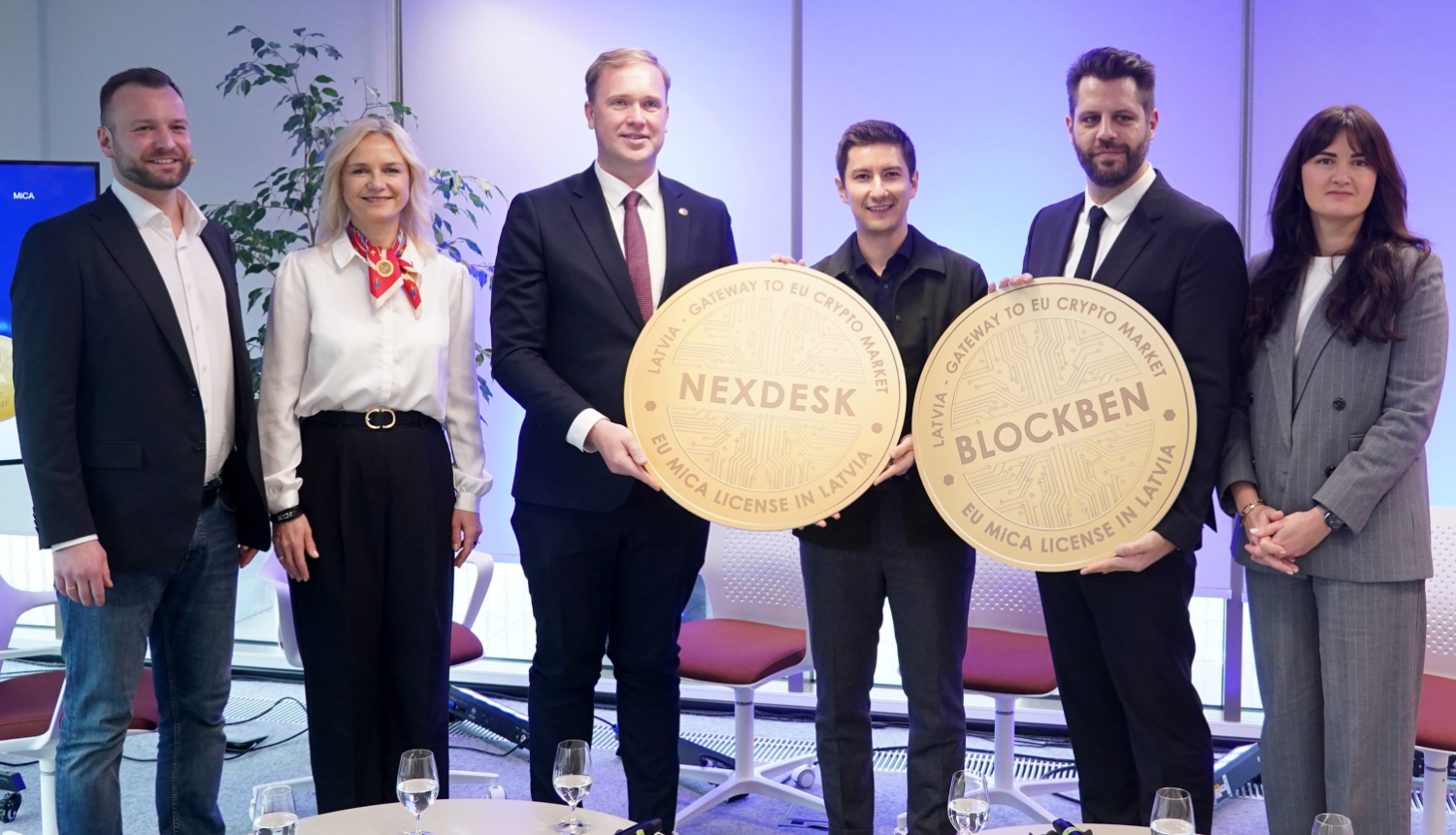
Today, at a press briefing for a wider audience, the first two companies, “BlockBen” and “Nexdesk”, were presented as recipients of MiCA licenses issued by the Bank of Latvia to operate in the EU crypto-asset market. The event was attended by Economics Minister Viktors Valainis, Deputy Director of the Investment and Development Agency of Latvia (LIAA) Laura Štrovalde, Deputy Governor of the Bank of Latvia Sanita Purgaile, Chairman of the Latvian Blockchain Association Reinis Znotiņš, and other industry representatives.
"The first MiCA licenses in Latvia are a clear signal that we are ready to become part of this global market. Transactions with crypto-assets in a regulated market open broad opportunities in finance beyond the traditional banking system. This allows for modern payment solutions between companies and the development of financial technologies. This sector creates highly skilled jobs and makes a significant contribution to Latvia’s services exports," emphasized Economics Minister Viktors Valainis during the briefing.
On December 3, the Supervisory Committee of the Bank of Latvia issued the first license for crypto-asset services to BlockBen, making it the first crypto-asset service provider in Latvia licensed under the MiCA regulation. Today, a license was also issued to Nexdesk. The license allows these companies to offer services not only in Latvia but across all EU member states, using the unified MiCA framework.
"The issuance of the first MiCA licenses will greatly facilitate LIAA’s work, as it is easier to attract future investors using concrete company examples. More than 100 companies from countries such as Switzerland, Poland, Lithuania, Spain, Italy, Japan, and Sweden have expressed interest. Latvian companies have already proven themselves in the fintech market, we have qualified specialists, and regulators maintain an open approach to crypto-asset transactions. This provides a foundation for the number of licenses issued to multiply tenfold within the next year," said Laura Štrovalde, Deputy Director of LIAA.
The average salary in the financial and insurance sector is about 40% higher than the national average. The sector almost entirely operates in service exports, which makes a significant contribution to the economy. For example, in Lithuania, fintech companies working solely with crypto-assets have paid over €80 million in taxes over the past four years.
"I, along with the entire BlockBen team, are pleased to have obtained the first MiCA license issued by the Bank of Latvia in Latvia. We have been actively operating in the market since early 2018, and I am confident that our business model as a cryptocurrency platform will offer many new opportunities. Latvia has high potential to become a new fintech hub in the EU and generate a multiplier effect for business development," said Viktors Bondars, CEO of BlockBen.
Currently, five companies have submitted license applications to the Bank of Latvia, while another twelve are in the pre-licensing consultation phase.
Looking to the near future, it is clear that due to the rapid development of digital asset infrastructure, crypto-assets will increasingly be integrated into corporate financial management and payments. The MiCA regulation is a strong signal that digital assets are becoming a fully regulated and strategically important part of the financial system. Following this trend, we are committed to continuing to ensure stable liquidity, competitive pricing, and a secure platform that allows companies to safely and efficiently manage asset movements between crypto and the traditional financial system," emphasized Sofiane Berrahal, board member of Nexdesk.
The crypto-asset and blockchain fintech sector is one of the fastest-growing and most export-oriented sectors in the world. Latvia’s competitive advantage in this market is the ability to obtain MiCA and other fintech licenses relatively quickly, with advisory support even in the pre-licensing phase.
"The crypto-economy is no longer a niche experiment — annual global transaction volumes already reach tens of trillions of euros. Thanks to the unified MiCA regulation, Europe is becoming one of the largest and safest markets for crypto service development, and our region already accounts for a significant share of global activity. Latvia was the first country in Europe to implement the MiCA regulation, and issuing these first licenses is the next step toward much faster sector growth. I want to thank the Ministry of Economics, LIAA, and the Bank of Latvia for supporting this sector’s development in Latvia. I sincerely hope that we will continue to move forward even faster so that Latvia becomes a Web3 hub in Europe," said Reinis Znotiņš, Executive Director of the Latvian Blockchain Development Association.
LIAA, the Ministry of Economics, the Bank of Latvia, and industry associations will continue working together to attract new MiCA license applicants. The joint goal is to make Latvia a recognized crypto and fintech hub in the Baltic and Nordic region.
The new Financial Technology Sector Strategy 2025–2027 aims to increase the number of fintech companies by 30%, attract 15% more investment, and increase the number of fintech-related jobs by 18%.
About LIAA:
LIAA promotes the competitiveness of Latvian entrepreneurs, export growth, and investment attraction, while also developing tourism and implementing national branding policy. The agency acts as a state partner in business development — from idea to international markets. With a broad network of foreign representations and regional business centers in Latvia, LIAA helps companies grow and positions Latvia as a safe, innovative, and open country in the global economy.
Photo: MiCA licenses
