


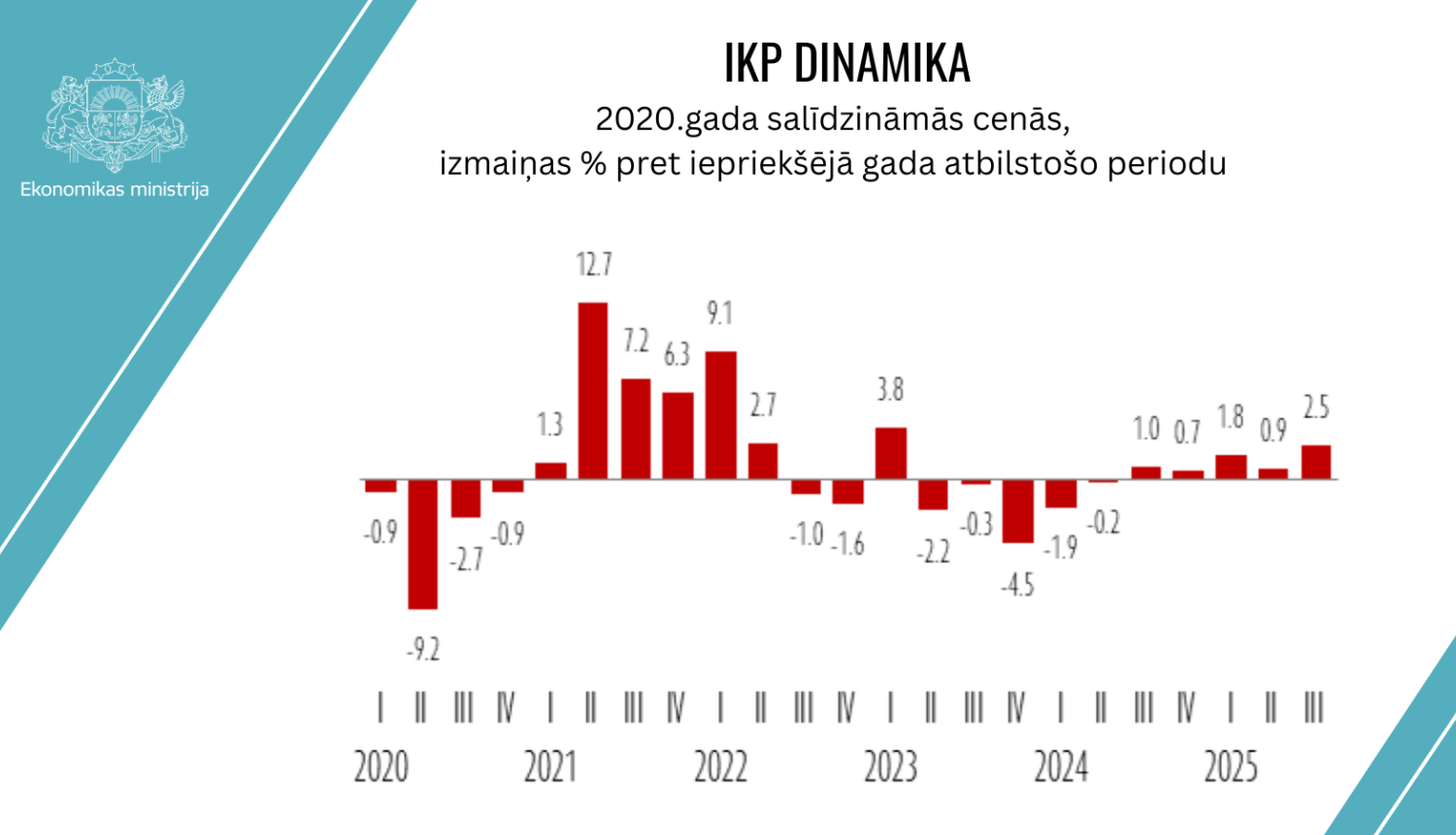
Despite the challenging geopolitical situation and ongoing uncertainty, Latvia’s economy has successfully overcome the shocks experienced in recent years and achieved a 2.5% growth in gross domestic product (GDP) in the third quarter compared to the same period last year.
In the third quarter, GDP at constant prices was 2.5% higher than a year ago. Meanwhile, GDP for the first three quarters of this year increased by 1.7% compared to the same period last year, according to data from the Central Statistical Bureau (CSB).
“The GDP growth in the third quarter suggests a more positive overall annual outcome, driven by the current growth engines – manufacturing, construction, and trade. Overall, the economy has grown faster than pessimists predicted earlier this summer. Latvia’s situation is being supported by the increasing inflow of European Union funds, more favorable trends in external markets, and government measures to stimulate economic activity, particularly in lending and investment. The introduction of the bank solidarity tax has encouraged financial institutions to be more actively involved in financing economic needs,” emphasizes Minister of Economics Viktors Valainis.
As inflation stabilizes and real household incomes rise, household consumption in the third quarter was 1.8% higher than a year ago, representing a relatively stronger increase than in the first two quarters.
Investments also increased significantly, driven by faster absorption of EU funds and growth in private sector lending. For example, by the end of September 2025, compared to the same period last year, loans to non-financial corporations grew by 16.1% and to households by 9.6%. Gross fixed capital formation in the third quarter increased by 10.8% year-on-year, largely due to investments in construction and buildings (+10.9%) as well as machinery and equipment, including transport vehicles (+15.2%). Positive growth was also observed in investment in intellectual property products (+1.5%).
Exports of goods and services in the third quarter were 3.0% higher than a year ago. Goods exports rose by 2.8%, while services exports increased by 3.2%. This indicates moderate but stable growth, supported by external demand and businesses’ ability to diversify markets. Growth in goods exports was primarily driven by wood and wood products (excluding furniture), electrical appliances and equipment, and mineral products. Growth in services exports was influenced by increases in transport and other business services.
Imports in the third quarter increased by 5.8%, including goods imports (+4.9%) and services (+8.8%). The main imported goods were mineral products, electrical appliances and equipment, and land transport vehicles and parts, while the growth in services imports was mainly driven by transport and other business services.
The largest contributions to Latvia’s GDP growth in Q3 2025 came from manufacturing, construction, and trade. Manufacturing grew by 7.3%, with particularly strong dynamics in food production and wood products manufacturing. Only 6 of 22 manufacturing sectors experienced negative growth. Construction also grew rapidly (+9%), largely due to large-scale investments in infrastructure projects such as roads, bridges, and electricity supply. The value added in trade increased by 3.1%, including retail (+1.3%).
Accommodation and food services contributed significantly to GDP growth, exceeding last year’s level by 4.9% in Q3. Positive dynamics were also observed in other sectors of the Latvian economy. Other industrial sectors grew by 1.1%, mainly due to increases in electricity, gas, heat, and air-conditioning supply (+7.3%).
Lower growth was recorded in information and communication technologies (+2.6%), real estate operations (+3%), commercial services (+2.6%), and public administration and education (+1.2% and +0.3%, respectively).
Negative value-added dynamics were observed in agriculture (-2%), mining (-24.2%), largely due to adverse weather conditions, and health and social care (-2.4%).
Sentiment indicators point to expectations of further growth, supported by the gradual recovery of household purchasing power.
The Ministry of Economics forecasts that GDP growth this year could exceed the previously projected 1.6%, and next year, despite unfavorable geopolitical conditions, the economy is expected to grow by at least 2.2%.