


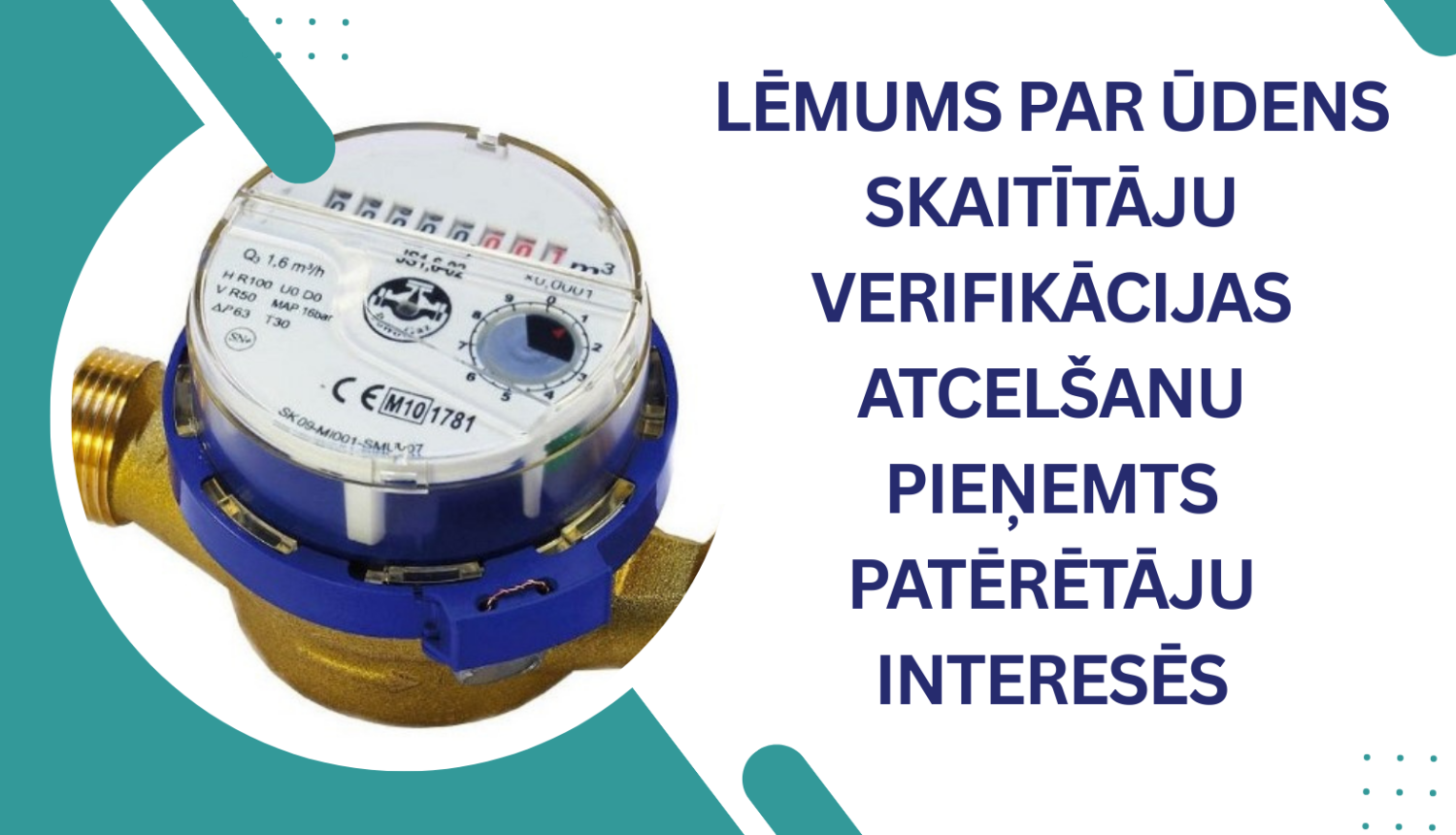
On 17 December, a case was initiated in the Constitutional Court (CC) regarding the termination of state metrological control, i.e., verification, of water consumption meters installed in apartments. The Ministry of Economics (MoE) explains that the decision was made in the interest of consumers, in order to avoid costs for testing low-quality water meters.
On 3 June, the government approved Cabinet of Ministers regulations listing measuring instruments subject to state metrological control, which provided for ending the control (verification) of water meters installed in apartments. Market monitoring conducted by the Consumer Rights Protection Centre (CRPC) in 2024 found that in 70% of cases, non-compliant meters were returned to apartments after verification.
The case submitted to the Constitutional Court on 17 December is titled: “On the compliance of points 4.5 and 4.6 of Annex to Cabinet of Ministers Regulation No. 289 of 14 May 2024, ‘Regulations on the list of measuring instruments subject to state metrological control,’ with Article 1 and the first three sentences of Article 105 of the Constitution of the Republic of Latvia.” According to the submitters, the cancellation of verification was illegal and abrupt, but the MoE emphasizes that businesses were informed during the regulatory drafting process about the issues and the rationale behind the proposed solution.
Following market monitoring conducted by the CRPC in 2024, it was concluded that apartment water meter verification had been largely formal, with costs borne by consumers—i.e., residents paid for verification services trusting that the checks were carried out properly. In reality, residents paid for work that the responsible institutions either did not perform or performed inadequately. Significant violations were found in the activities of water meter verifiers, which affected the interests of all consumers.
In this case, attention must be paid not only to the legal interests of individual businesses but also to the interests of consumers—in this instance, apartment owners—who are the less protected party in these legal relationships. From 2020 to 2023, 975,809 water meters were verified, costing residents EUR 19.5 million, or approximately EUR 5 million per year.
To end water meter verification, four regulatory acts were drafted, coordinated, and adopted by the Cabinet of Ministers at the beginning of 2025, during which the MoE informed businesses of the upcoming changes. In its announcement of 10 April 2025, the MoE informed businesses that cancelling the requirement for repeated verification of water meters would reduce demand for this service. As a result, businesses providing such services were advised to plan for reorientation and diversification of their commercial activities. It should be emphasized that the decision does not prohibit businesses from offering these services, which they can freely provide in the market, competing with each other and ensuring service quality.