


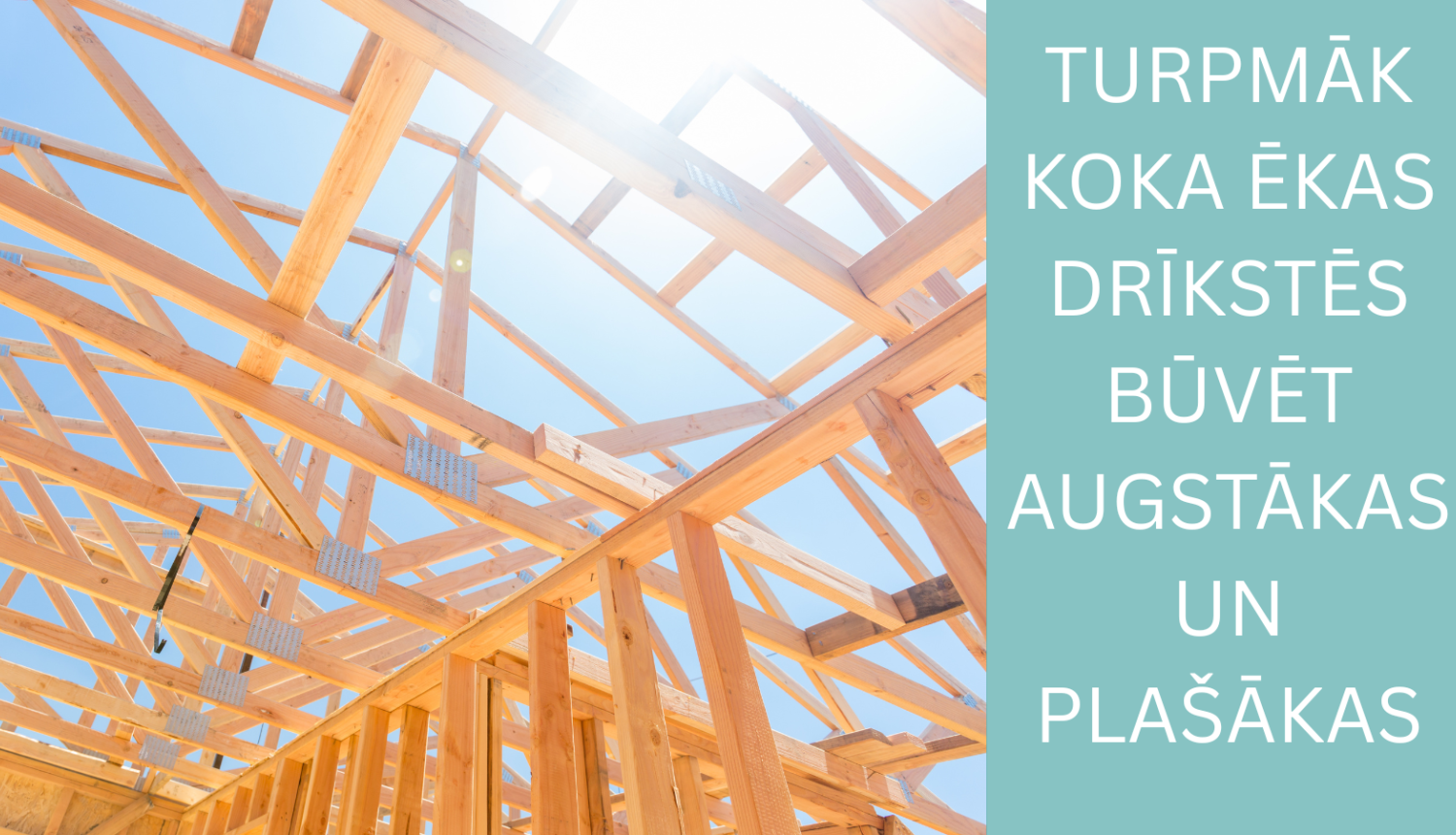
Restrictions on the use of wood in large industrial and public buildings are being revised – in the future, wood can be widely used in buildings with higher fire-resistance ratings, provided that appropriate fire safety systems are installed.
This is set out in amendments to the Cabinet of Ministers regulations No. 333 of June 30, 2015, “Regulations on the Latvian Building Code LBN 201-15 ‘Fire Safety of Buildings’,” drafted by the Ministry of Economics (ME), which were approved by the government on Tuesday, December 9.
“These amendments are an important step toward sustainable construction, as using wood reduces carbon emissions and supports the development of the local woodworking and construction sectors. The new regulations will allow progress to the next stage of wooden construction in Latvia – from low-rise buildings to multi-story, energy-efficient, and climate-neutral buildings – while making the requirements more precise and aligned with modern construction practices,” said Minister of Economics Viktors Valainis.
Until now, wood as the main load-bearing construction material was only allowed in buildings with lower fire-resistance ratings. For example, for residential buildings, offices, and public buildings, wood was permitted up to a top floor height of 18 meters and a total area of 2,000 m². For production and warehouse buildings, wooden load-bearing structures were only allowed up to 8 meters in height and 2,000 m² in area, while in hospitals, care homes, social facilities, schools, and kindergartens, wood was even more restricted – only up to 8 meters and 800 m².
In the future, if appropriate safety measures are implemented – for example, automatic fire suppression (sprinkler) systems, fire-resistant protective coatings on load-bearing structures, and smoke-protected stairwells – wood can be used in multi-story and large-scale buildings. Thus, the new regulations maintain a balance between broader use of wood in construction and fire safety.
With the entry into force of the regulations on January 1, 2026, multi-apartment residential buildings, schools, hospitals, and other similar-use buildings can be constructed up to a top floor height of 28 meters – approximately nine stories – with fire compartment areas up to 2,500 m². Public buildings, such as office, cultural, sports, or retail buildings, can also be built up to 28 meters, but with fire compartment areas up to 5,000 m², while production and warehouse buildings with lower fire loads can be built up to 10,000 m².
The amendments also include several clarifications to eliminate ambiguous and duplicate requirements. To ensure a consistent and clear design approach, requirements for external wall insulation materials and the placement of fire-resistant separating strips are specified. References to outdated standards and duplicate requirements for firefighting water supply have been removed, as these matters are covered in other regulations.
Additionally, more proportionate rules are introduced for smaller-scale buildings – for example, interior staircases in single-family homes will no longer be subject to the same fire-resistance requirements as public evacuation staircases.
In reconstruction cases, it will be possible to retain existing floor structures if fire safety is ensured by other solutions, such as fire-resistant coatings or cladding. This means that in buildings with wooden or hybrid floors, it will no longer be mandatory to construct a new concrete floor if an equivalent level of safety can be achieved with modern materials and technical solutions.