


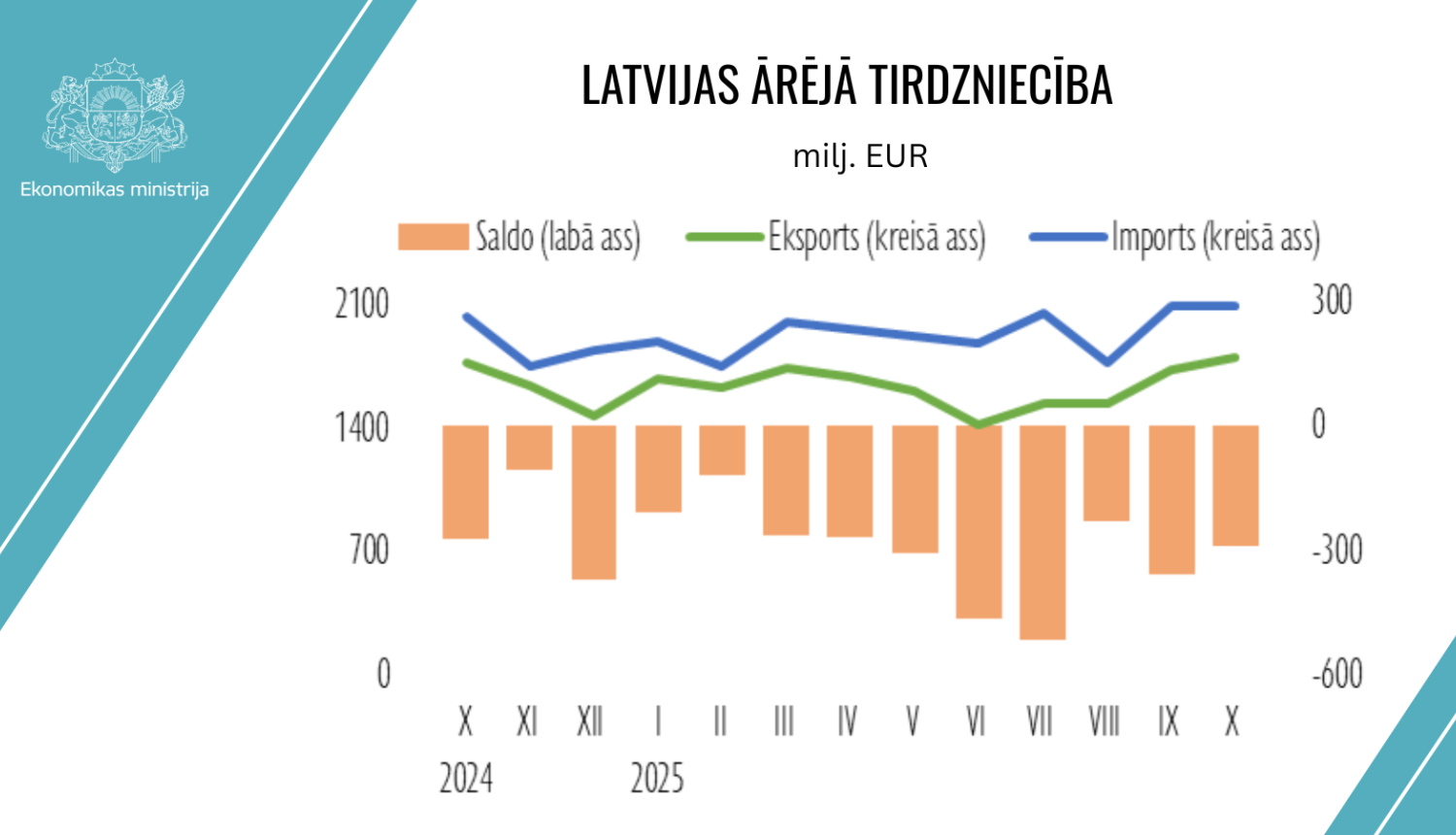
In October, the value of goods exports continued to rise, maintaining a stable growth trend on an annual basis. Export development is largely supported by businesses’ ability to quickly and flexibly adapt to changing conditions, which is crucial amid global economic fluctuations, geopolitical risks, and supply chain challenges. This adaptability allows companies to remain competitive and promotes export growth.
In October, the value of goods exports at current prices was 2.2% higher than a year ago, while imports increased by 2.9%. The trade deficit in October stood at 7.4% on an annual basis.
Overall, in the first ten months of 2025, goods exports at current prices were 4.3% higher than the same period last year, while goods imports increased by 7.3%.
On an annual basis, export values grew most rapidly for land transport vehicles, mineral products, electrical equipment and devices, and pharmaceutical products. Meanwhile, exports decreased for cereals, other chemical products, and oilseeds.
In October 2025, compared to October of the previous year, exports to EU countries increased relatively sharply by 6.8%. Export values rose particularly to several member states: Lithuania (vehicles, pharmaceuticals), Spain (cereals), Denmark (wood, electrical equipment), Estonia (mineral products), and Germany (vehicles, wood). In contrast, exports to Belgium decreased (oilseeds).
Exports to CIS countries continued to decline in October, falling by 1.6%. Exports to Kazakhstan decreased (electrical equipment, perfumery), while exports to Belarus increased (optical devices). Exports to Russia rose by 1.5%, with the majority of exports to Russia still consisting of various alcoholic beverages.
Exports to other countries also fell in October, down 8.2%. This was largely due to reduced cereal exports to Nigeria and Morocco, as well as decreased mineral product exports to Morocco and Tunisia. On the other hand, exports increased to the United Kingdom (wood) and Kenya (cereals).
On the import side, annual growth in October was positively influenced by higher import values of electrical equipment and devices, land transport vehicles, machinery, pharmaceuticals, and weapons and ammunition. Meanwhile, imports of mineral products declined.
Notably, imports from CIS countries fell sharply in October, by 56% overall, including an 85% decline from Russia and 35% from Belarus. Imports from CIS countries accounted for only 0.8% of total goods imports in October, with imports from Russia making up just 0.2%.