


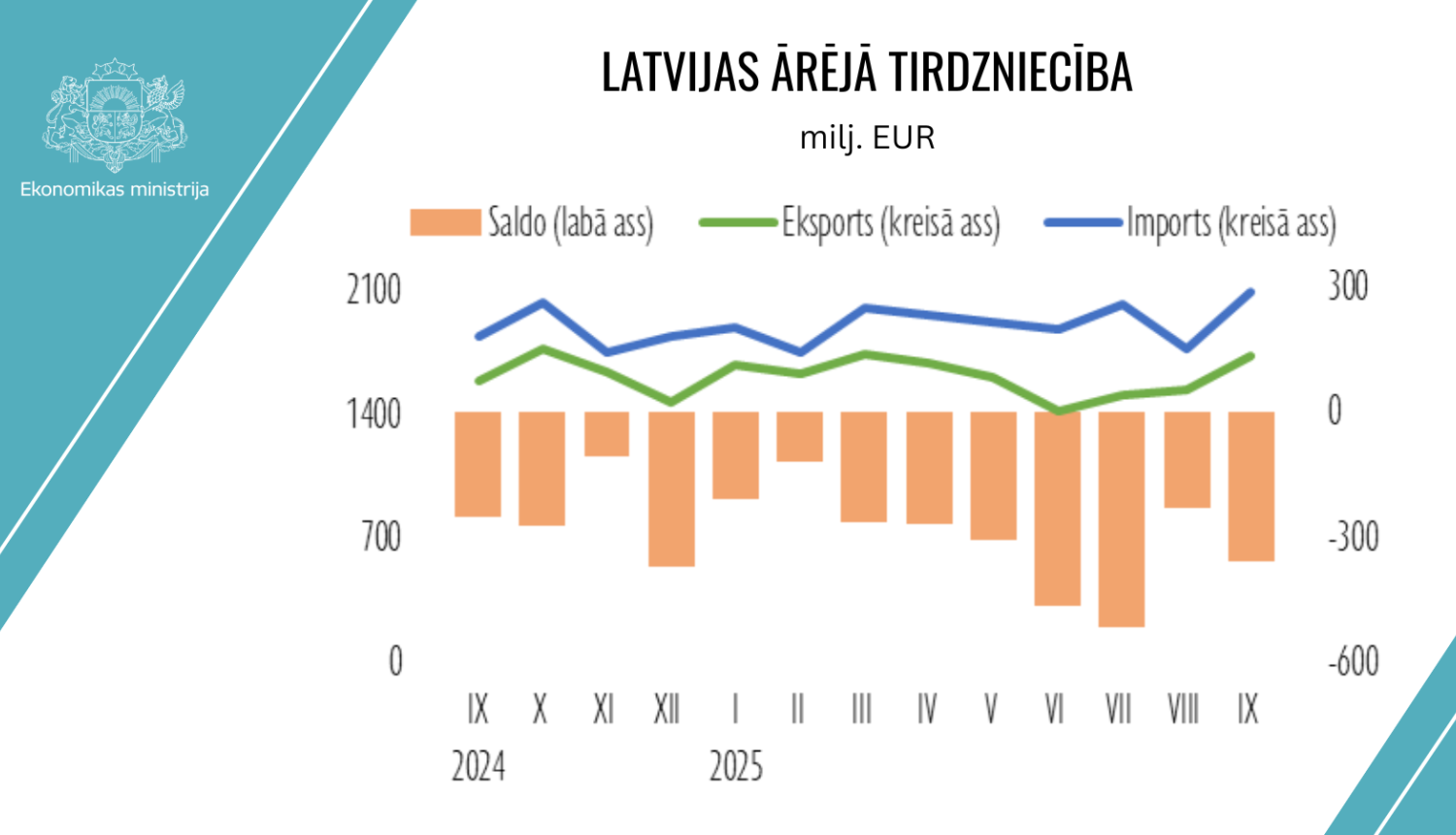
In September of this year, both exports and imports in Latvia increased sharply, indicating stable economic growth.
Goods exports showed steady growth in September, contributing to overall export growth for the year. Export development continues to be driven by consistently strong external demand and businesses’ ability to adapt to changing conditions. These factors are particularly important given global economic fluctuations, geopolitical risks, and supply chain challenges.
In September, the value of exported goods at current prices was 8.8% higher than a year earlier, while imports increased by 13.5%. The trade deficit in September on a year-on-year basis was 9.3%.
Overall, in the first three quarters of 2025, the value of goods exports at current prices was 4.4% higher than in the same period last year, while imports rose by 7.7%. This reflects growth supported by stable external demand and the ability of companies to diversify their markets.
Year-on-year, the export value of oilseeds, land transport vehicles, wood and wood products, mineral products, dairy products, and pharmaceuticals increased significantly, while the export value of vegetables and other chemical products decreased.
In September of this year, compared to September 2024, exports to EU countries rose sharply by 14.6%. Export values increased most rapidly to Spain (grains), Germany (vehicles, oilseeds), Italy (grains, wood), Lithuania (vehicles, dairy products), and Romania (grains). Export volumes to CIS countries continued to decline, down 2.4%. Exports to Belarus decreased (pulp), while exports to Russia rose slightly by 1% (pharmaceuticals, footwear), with a large share still consisting of alcoholic beverages. Exports to other countries fell slightly by 3.3%, mainly due to reduced grain exports to Nigeria and Côte d’Ivoire and lower oilseed exports to Egypt. Meanwhile, exports to Turkey increased (iron and steel).
Year-on-year, the increase in imports in September was positively influenced by higher imports of vehicles, electrical equipment, pharmaceuticals, and weapons and ammunition, while imports of railway transport equipment decreased.